 Arrakisfinance
 vaults in Arrakis Pro give their NFT holders control over the underlying assets
· updated
Arrakisfinance vaults in Arrakis Pro are smart contracts that hold managed liquidity, with asset control attached to the vault's non-fungible token. The issuer chooses the strategy parameters, and Arrakis operates the market-making system. Owning the vault NFT carries withdrawal rights over the underlying assets.
What does an Arrakis Pro vault NFT control?
The Arrakis Pro vault NFT gives its holder control over the underlying assets, including withdrawal rights and the ability to pause or reconfigure the vault. Changes to core parameters follow a separate timelock. Arrakis operates the strategy within the issuer's chosen parameters.
A non-fungible token, or NFT, identifies a particular vault's ownership. Here, the token carries authority over assets managed through smart contracts. Routine market making doesn't require the issuer to hand the ownership token to the operator.
Transferring the vault NFT transfers control of the underlying funds.
Someone who gains control of that token gains control over the vault's assets.
The deployment handover places the vault NFT in the team's multisig or MPC wallet. The wallet's signing configuration determines how the team authorizes actions through that ownership token.
The Pro vault model and its PALM history
Arrakis Pro's vault model manages protocol-owned liquidity: assets that a token project supplies from its own treasury. The vault operates on a decentralized exchange, or DEX, under the team's selected strategy. Arrakis announced PALM's rebrand to Arrakis Pro on November 7, 2024.
The contract components behind a vault
Arrakis Modular combines a core vault with a DEX-specific module that holds liquidity, plus an optional Uniswap v4 hook where the deployment uses one.
The core vault and liquidity module
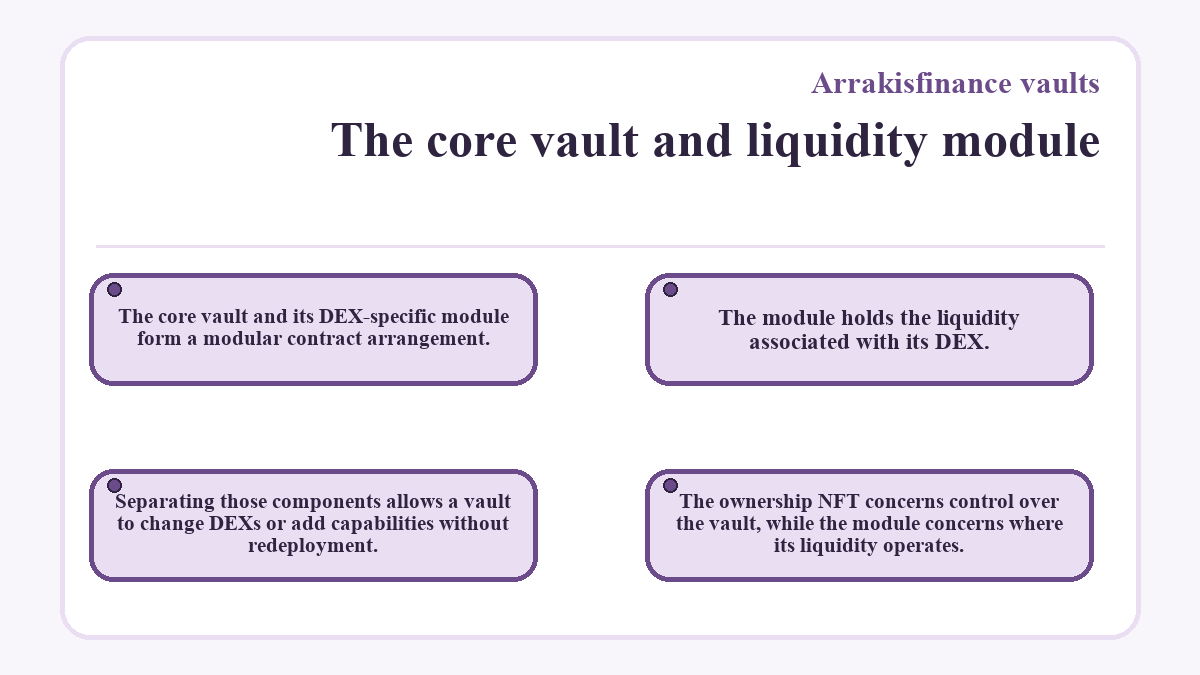
The core vault and its DEX-specific module form a modular contract arrangement. The module holds the liquidity associated with its DEX. Separating those components allows a vault to change DEXs or add capabilities without redeployment. The ownership NFT concerns control over the vault, while the module concerns where its liquidity operates.
Optional pool features
A Uniswap v4 hook adds a configured pool capability to the strategy. Price Convergence and Dynamic Fees belong to that optional layer. Their presence follows the deployment's configuration, so describing an Arrakis Pro vault doesn't establish that either hook is active. The strategy remains responsible for its liquidity and inventory objective.
Does the two-day timelock delay withdrawals?
Arrakis Pro's two-day timelock applies to core-parameter changes, while the vault NFT holder retains the right to withdraw assets at any time.
Ordinary strategy activity
Arrakis adjusts the strategy during normal management as markets change. Rebalancing within the existing configuration belongs to that ongoing operation. It doesn't make every price-range adjustment a new core-parameter change or create a fresh two-day withdrawal restriction.
Changes to core parameters
Changes to an Arrakis Pro vault's core parameters are subject to a two-day timelock. That interval gives the owner time to assess the proposed change or exit. It doesn't set the strategy's rebalance frequency or describe how long a withdrawal transaction takes.
Continuous management between owner decisions
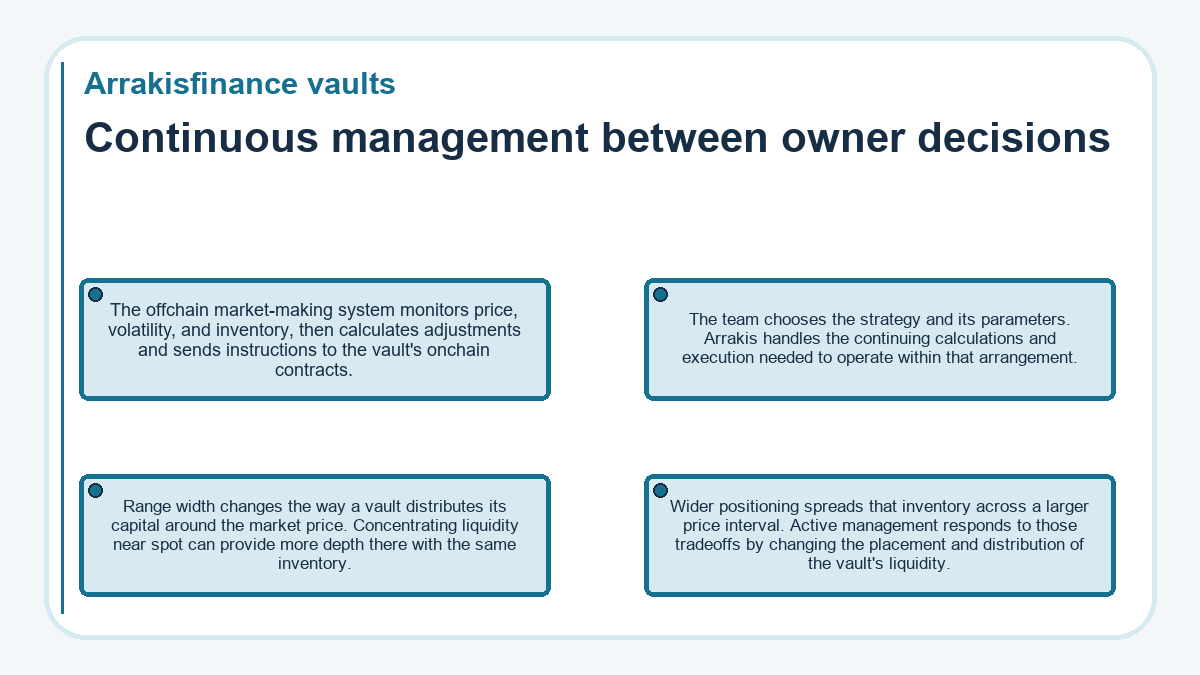
The offchain market-making system monitors price, volatility, and inventory, then calculates adjustments and sends instructions to the vault's onchain contracts. The team chooses the strategy and its parameters. Arrakis handles the continuing calculations and execution needed to operate within that arrangement. Range width changes the way a vault distributes its capital around the market price. Concentrating liquidity near spot can provide more depth there with the same inventory. Wider positioning spreads that inventory across a larger price interval. Active management responds to those tradeoffs by changing the placement and distribution of the vault's liquidity.
What happens when a position leaves its range?
A Uniswap v3 or v4 concentrated-liquidity position stops earning swap fees when the market price moves outside that position's selected price range. Trading also changes the position's composition. As the price moves through its range in one direction, the position can end up holding only one of its assets. An unchanged Uniswap v3 or v4 position becomes active again when the market price returns inside its range. Active management can also change liquidity placement. Fee eligibility therefore follows the liquidity's range and the market price, rather than ownership of the NFT.
Strategy and hook choices for vault configuration
Arrakis Pro's strategy choices set an inventory or liquidity objective, while its optional Uniswap v4 hooks add pool behavior when configured at deployment. A vault can combine a chosen strategy with an applicable hook capability.
| Strategy or optional addition | Applicable assets or market conditions |
|---|---|
| Bootstrap strategy | Launch inventory weighted toward or entirely in the project token; builds ETH or stablecoin reserves through trading. |
| Flagship strategy | Ongoing token markets with quote assets available to pair with the project token; concentrates around spot and adapts positioning to volatility. |
| Yield-Bearing Asset strategy | Tokens that accrue value through yield; maintains sell-side liquidity within range. |
| Treasury Diversification strategy | Project-token holdings intended for gradual conversion into quote assets. |
| Customized strategy | Pairs with specific requirements that need a tailored strategy. |
| Price Convergence hook | Compatible Uniswap v4 pools tracking an external asset value or matching a centralized-exchange listing price at launch. |
| Dynamic Fees hook | Compatible Uniswap v4 pools where the fee tier responds to volatility and trading momentum. |
| These options change the vault's market behavior; control over its assets remains attached to the vault NFT. | |
Where converted quote assets remain
Bootstrap and Treasury Diversification both convert project-token inventory through market demand, but the strategies use the accumulated quote assets differently inside the vault arrangement. Bootstrap keeps captured quote assets deployed in liquidity as inventory moves toward the configured target ratio. Reaching that target triggers the move to Flagship.
Treasury Diversification removes captured quote assets from the pool and retains them in the vault. Its mandate is to convert the targeted project-token holdings, rather than graduate to ongoing balanced-liquidity management. That difference affects what a growing quote balance represents: inventory supporting continued market making in one strategy, and assets set aside from pool liquidity in the other.
Onchain visibility and continuing market exposure
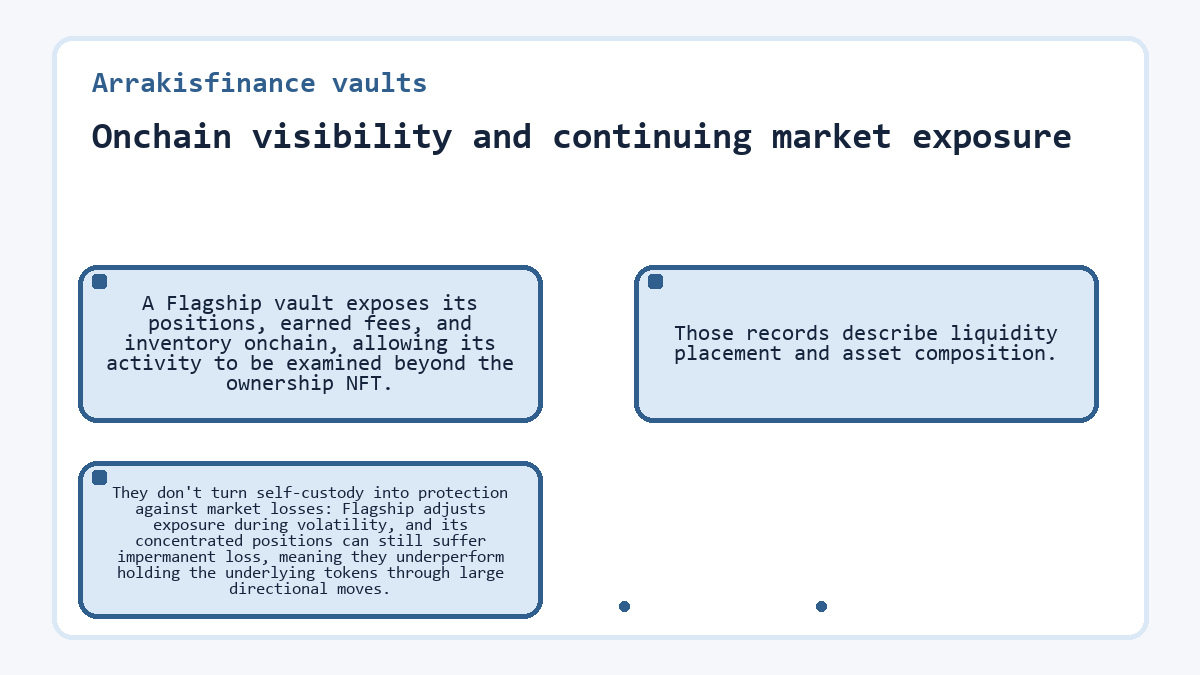
A Flagship vault exposes its positions, earned fees, and inventory onchain, allowing its activity to be examined beyond the ownership NFT. Those records describe liquidity placement and asset composition. They don't turn self-custody into protection against market losses: Flagship adjusts exposure during volatility, and its concentrated positions can still suffer impermanent loss, meaning they underperform holding the underlying tokens through large directional moves.
Vault setup before delegated management
Vault setup establishes the market and management settings before Arrakis deploys the configured contracts and transfers the ownership NFT to the issuer's team.
The pool and position settings
Configuration identifies the pool, fee tier, price range, strategy schedule, and any applicable hook settings. These choices connect the intended inventory objective to a particular liquidity deployment. A strategy name alone doesn't specify every setting that governs the resulting vault.
The owner's control address
The team's wallet holds the NFT that carries the vault rights. Its identity therefore matters alongside the pool configuration. Correct liquidity settings don't compensate for handing the ownership token to the wrong holder, because the token itself carries authority over the assets.
The vault's objective as inventory needs change
The vault NFT holder authorizes changes to the active strategy as the team's inventory needs evolve, while core-parameter updates remain subject to their timelock. Reconfiguration changes the management mandate under the same ownership model.
The next choice concerns how the team intends to use its existing inventory. Ongoing market making calls for liquidity positioned around trading activity. Treasury conversion calls for accumulating quote assets from the targeted project-token holdings.
Arrakisfinance vaults questions, answered
Do issuers pay gas for each routine vault rebalance?
Arrakis Pro handles routine market-making operations without gas payments or manual actions from the issuer's team. It doesn't establish a complete fee schedule for deployment, withdrawals, or other interactions with the vault.
Can one team keep market-making and treasury-conversion strategies in separate vaults?
A team can operate several independent, self-custodial Arrakis Pro vaults in parallel, each with its own strategy. Ongoing liquidity management and treasury conversion can therefore have separate vault mandates. The team retains custody of each vault through its ownership NFT while allocating inventory to different objectives.
Why might a Flagship vault react slowly to a sudden price move?
Flagship checks rebalances against a time-weighted average price, or TWAP, which can delay its response to a genuine rapid move. The check helps prevent reactions to brief price spikes that could reflect manipulation.
What happens to a Bootstrap vault if the token price falls before conversion finishes?
A Bootstrap vault's response to a falling price depends on its configuration. Some deployments follow the lower market price and continue converting at those levels. Others pause conversion and resume only after recovery. The strategy can also widen positions and reduce deployed capital as conditions warrant, while any unconverted project-token inventory remains exposed to price changes.
How long does treasury conversion take inside a vault?
A Treasury Diversification vault converts inventory as trading demand reaches its positions, so completion time depends on volume and configuration. Lower activity slows conversion. More aggressive settings can accelerate fills at lower average prices. Arrakis estimates weeks to a month in a moderately liquid market.
Does a vault migration always happen in one transaction?
A migration into an Arrakis Pro vault isn't always a single transaction. A Uniswap CCA-seeded v4 full-range position has a dedicated atomic migration route. Other manually managed Uniswap v3, v4, or Slipstream positions typically follow withdrawal and deposit into a new vault. Coordinated alternatives depend on the existing setup, including whether substantial prefunding can support a migration without interrupting liquidity.