 Arrakisfinance
 adds optional Uniswap v4 hooks to Arrakis Pro strategies
· updated
Arrakisfinance uses optional Uniswap v4 hooks to add price alignment or variable pool fees to Arrakis Pro strategies. Price Convergence aligns a pool with an external reference, while Dynamic Fees responds to volatility and trading momentum. Both are features configured at deployment. They complement the system that manages concentrated liquidity, and their presence depends on the vault configuration.
A liquidity strategy sets the vault's inventory and positioning objective. A hook adds a specific pool behavior on top of that strategy. A price-aligned market and an actively rebalanced position answer different needs.
The hook's place in the market-making system
Arrakis Pro combines onchain vault contracts with an offchain system that manages liquidity. A DEX-specific module holds the liquidity, and an optional Uniswap v4 hook adds pool features. The offchain system monitors prices, volatility, and inventory, then sends management instructions to the vault.
Price Convergence and external market values
The optional Price Convergence hook aligns a pool's price with an external reference. For real-world assets, the reference connects pool pricing to the offchain value that the token tracks. The target comes from a valuation outside that pool's trading activity.
Yield-bearing tokens create a related pricing task because their value accrues through yield. Arrakis Pro's Yield-Bearing Asset strategy maintains sell-side depth for that token type. Maintaining sell-side depth and aligning a pool price address different parts of that market's design.
The same hook also supports matching a centralized exchange listing price at launch, so its scope extends beyond yield-bearing assets.
Price alignment describes the pool's relationship to its reference. A swap still trades against available liquidity, which affects price impact. Matching a reference price and supporting a particular trade size are different properties of a market.
Dynamic Fees and volatile trading
Dynamic Fees adjusts the fee tier in response to volatility and trading momentum when the deployment includes that hook. The hook targets higher swap fees on volatile flow and lower fees on quiet flow. The change concerns the fee that the pool charges for trading. The offchain market-making system also monitors volatility, alongside price and inventory, as it manages the position. These related inputs support different decisions: choosing liquidity ranges and setting a pool's fee behavior each address a specific part of market making.
Concentrated ranges and fee eligibility
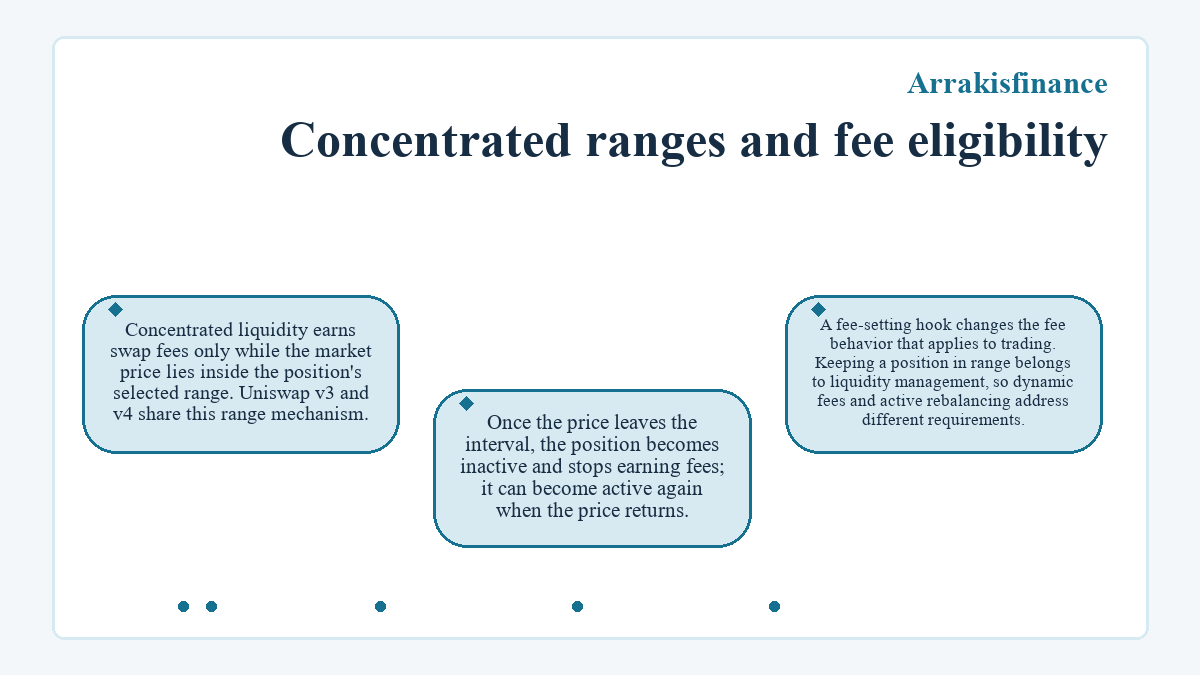
Concentrated liquidity earns swap fees only while the market price lies inside the position's selected range. Uniswap v3 and v4 share this range mechanism. Once the price leaves the interval, the position becomes inactive and stops earning fees; it can become active again when the price returns. A fee-setting hook changes the fee behavior that applies to trading. Keeping a position in range belongs to liquidity management, so dynamic fees and active rebalancing address different requirements.
Strategy choices beneath the hook layer
Arrakis Pro offers strategy choices that address inventory and liquidity placement beneath the hook layer.
| Strategy | Liquidity objective | Applicable condition or transition |
|---|---|---|
| Bootstrap | Accumulate ETH or stablecoins on the quote side. | Begins with launch inventory skewed toward the project token, then automatically transitions to Flagship. |
| Flagship | Concentrate liquidity around the spot price and adapt to volatility. | Provides ongoing management for mature markets. |
| Yield-Bearing Asset | Maintain sell-side depth within range. | Applies to tokens that accrue value through yield. |
| Treasury Diversification | Convert project tokens into quote assets over time. | Uses organic trading to change the inventory. |
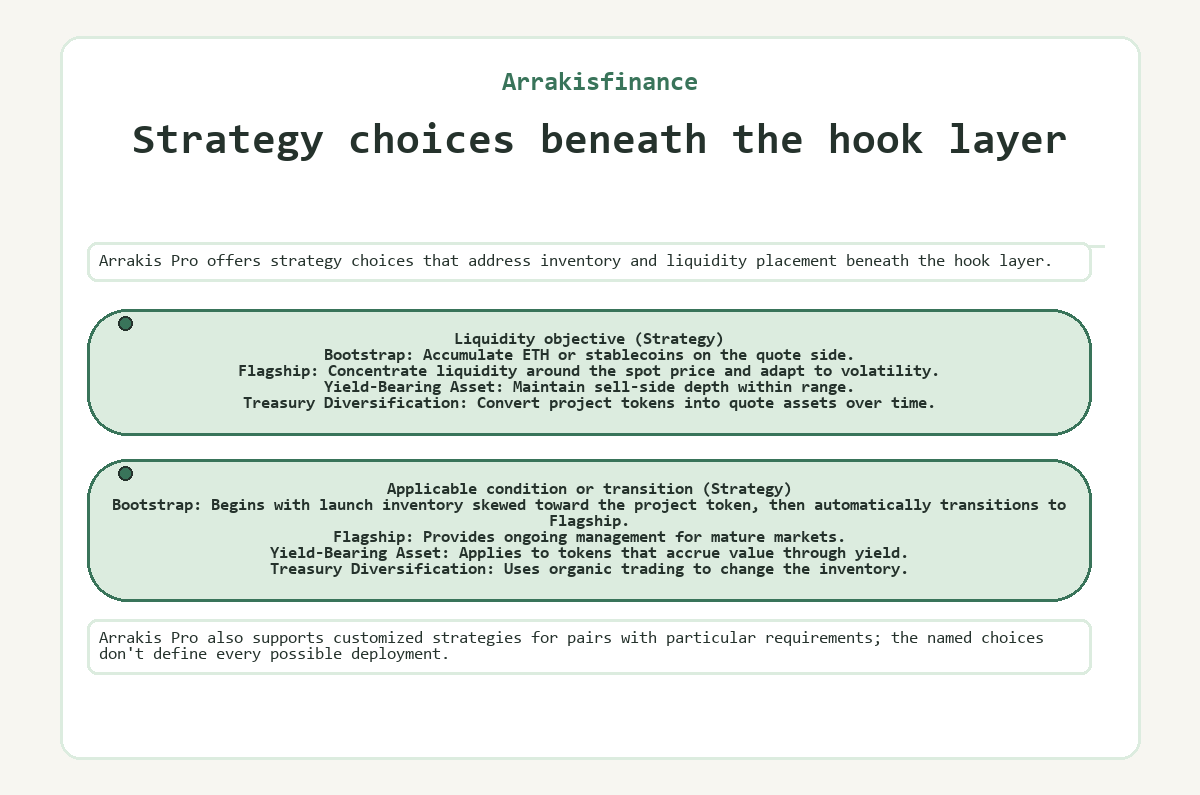
Arrakis Pro also supports customized strategies for pairs with particular requirements; the named choices don't define every possible deployment.
Swap fees and position performance
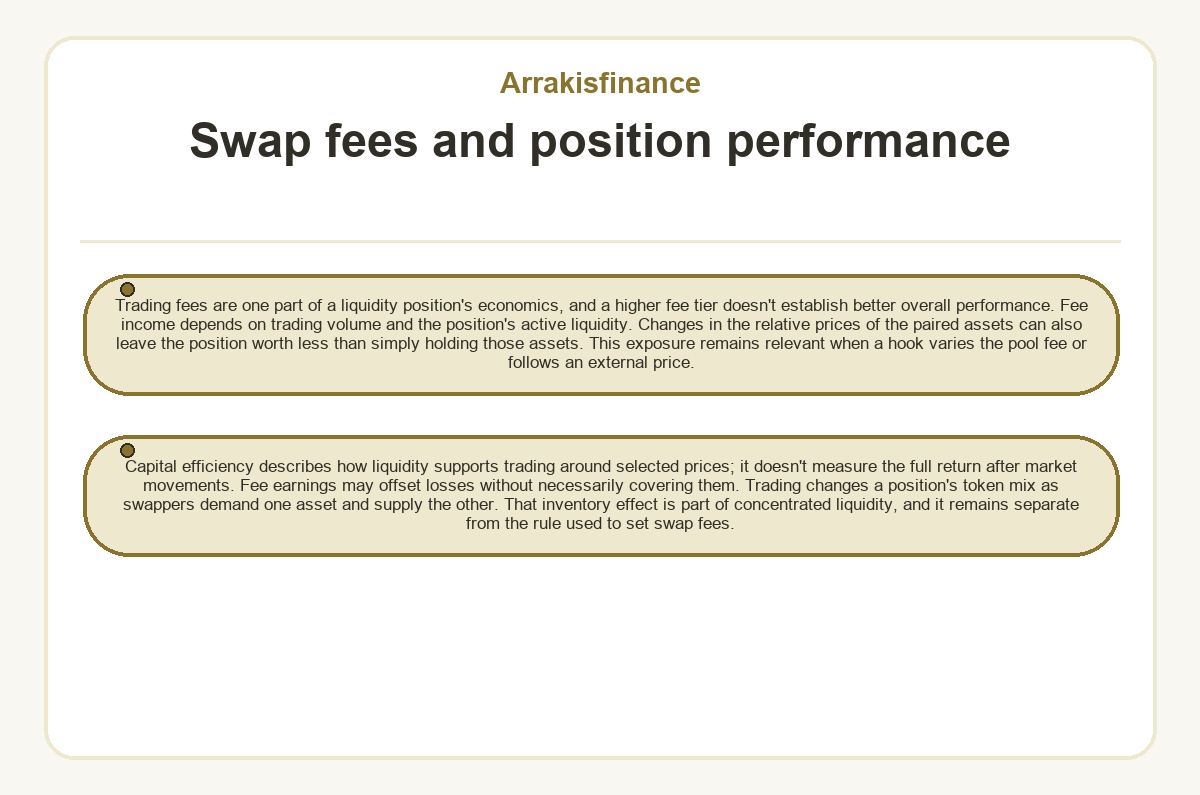
Trading fees are one part of a liquidity position's economics, and a higher fee tier doesn't establish better overall performance. Fee income depends on trading volume and the position's active liquidity. Changes in the relative prices of the paired assets can also leave the position worth less than simply holding those assets. This exposure remains relevant when a hook varies the pool fee or follows an external price. Capital efficiency describes how liquidity supports trading around selected prices; it doesn't measure the full return after market movements. Fee earnings may offset losses without necessarily covering them.
Trading changes a position's token mix as swappers demand one asset and supply the other. That inventory effect is part of concentrated liquidity, and it remains separate from the rule used to set swap fees.
Deployment settings and later strategy adjustments
The deployment configuration specifies the optional Uniswap v4 hook features in an Arrakis Pro vault. Changes to an Arrakis Pro vault's core parameters are subject to a two-day timelock. That period gives the owner time to review a core change or exit; it isn't an interval for routine rebalancing. The modular framework also allows a vault to move between DEXs or add capabilities without redeployment.
A strategy name alone doesn't identify the enabled hooks. Price alignment and adaptive fees require their respective configured features.
Questions and answers about Arrakisfinance
Does Dynamic Fees describe a liquidity mining reward rate?
Dynamic Fees describes the swap fee that a configured pool charges, not a liquidity mining reward rate. Liquidity mining concerns separate incentives for supplying liquidity. A changing pool fee therefore doesn't establish that the deployment includes a reward program.
Do Uniswap v3 positions automatically receive Arrakis Pro's Uniswap v4 hooks?
A Uniswap v3 position doesn't acquire Arrakis Pro's optional Uniswap v4 hooks merely by using the same liquidity strategy. Both versions use concentrated ranges, which explains some shared terminology.
Are issuers charged gas for routine management of hook-enabled Arrakis Pro vaults?
Arrakis Pro's ongoing market-making operation requires no gas costs or manual action from the issuer team. That applies to continuous position management; it isn't a blanket fee rule for every vault transaction or trade involving the pool.
Can a changing pool fee confirm that Price Convergence is active?
A changing pool fee doesn't by itself show that an external-price feature is active. Dynamic Fees and Price Convergence are separately named optional hooks with different jobs.